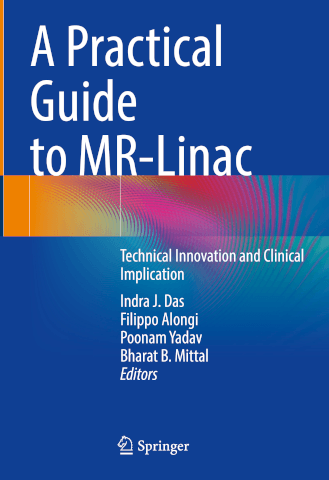
A Practical Guide to MR-Linac: Technical Innovation and Clinical Implication
Additional information
|
Author(s):
Das, Alongi, Yadav, Mittal | Das, Alongi, Yadav, Mittal |
|
ISBN:
978-3-031-48165-9 | 978-3-031-48165-9 |
|
Publisher:
Springer | Springer |
|
Reviewed by:
Trina Herbert, MR linac superintendent therapeutic radiographer, The Royal Marsden NHS Foundation Trust, London | Trina Herbert, MR linac superintendent therapeutic radiographer, The Royal Marsden NHS Foundation Trust, London |
Publisher price: £139.99
The recent introduction of linear accelerators in combination with MR imaging technology represents the latest step in improving image guidance in radiotherapy. Image guidance has developed from plain x-rays through electronic portal imaging, CT guidance, ultrasound, surface guidance and now MRI.
The utilisation of MRI in all aspects of the radiotherapy pathway, from diagnosis and staging to tumour response assessment, has been expanding for several years. This integration of MRI as onboard image guidance represents a positive development in tumour targeting, treatment accuracy, margin reduction and dose escalation, all targeted towards better tumour control, fewer complications and better patient outcomes.
The multidisciplinary editorial team of this textbook has ensured that the perspective of each profession is represented by covering the entirety of the workflow and rationale for MR-linac use in each treatment site.
This book is well balanced, addressing the limitations surrounding the MR-linac as well as describing the advantages of this ‘transformative technology,’ with all vendors and designs represented. Limitations such as geometric distortions and susceptibility artefacts due to implanted devices are discussed, as are scheduling complications, resource intensity and increased appointment length. Many benefits and innovations are also described.
Following a comprehensive introduction into the technology, the practical applications, and various designs of the MR-linac, the text is divided into technical and site-specific chapters, allowing it to be efficiently accessible to any student or professional curious about a particular physics, technical, safety or treatment aspect. The site-specific chapters include disease overviews offering good revision of cancer aetiology and occurrence alongside common treatment approaches. These chapters are extremely detailed, offering practical advice regarding RT planning considerations, online MRI sequence suggestions, patient positioning, workflow advice and descriptions of current and recent clinical trials. Comparisons are also made with other treatment platforms. The text is well supported by an abundance of images, figures and tables, supporting the title of ‘A practical guide’.
There is a small yet significant section on patient selection and preparation that highlights the requirement to inform the patient of the length of workflow, the complexity and the safety considerations. MRI safety, while crucial, is well described in other textbooks so the small section included is required and appropriate. MRI safety training requirements are described in the ‘Education and training’ chapter. This chapter acknowledges that training throughout the multi-disciplinary team is key and related to roles and responsibilities within the MRI-guided radiotherapy (MRgRT) workflow. For example, therapeutic radiographers have a requirement to learn about all aspects of MRI, including safety, and may upskill to acquire online contouring responsibilities. It is highlighted that throughout the online workflow, each profession should have a good understanding of all aspects for discussions and rapid decision making in response to online scenarios.
Suggestions of training opportunities include vendor training, university-based training, international courses, online courses and visits to established centres for peer-to-peer training.
The ‘Treatment planning considerations’ chapter includes a high level of technical detail regarding hardware and software requirements. Recommendations of national and international guidelines are made throughout.
Renowned experts in this developing field from several international institutions collaborate to produce each section. This means that some themes, such as the benefits of image quality and the effect on image guidance confidence, are described at the opening of several sections. This may be seen repetitive, but it means chapters can be read in isolation without losing detailed information. Most chapters describe offline and online considerations for both ViewRay MRIdian and Elekta Unity systems, providing comprehensive detail.
Each centre presenting its work is generous with examples of treatment plans, department-specific dose constraints, technique descriptions and suggestions, with plenty of references enabling further study and access to information. This textbook is an essential companion for anyone interested or working in or studying MRgRT and would be an asset in any department’s library.
To purchase this title at our discounted rate email: katherine@radmagazine.com.