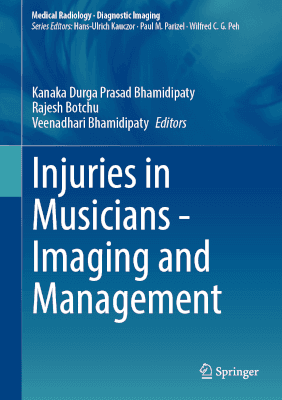
Injuries in Musicians – Imaging and Management
Description
Offers a comprehensive review of imaging modalities for evaluation of injuries in musicians.
Presents a review of various pathologies.
Emphasizes Imaging features of injuries and their management.
Additional information
|
Author(s):
Bhamidipaty, Botchu, Bhamidipaty | Bhamidipaty, Botchu, Bhamidipaty |
|
ISBN:
978-3-032-14364-8 | 978-3-032-14364-8 |
|
Publisher:
Springer | Springer |
|
Reviewed by:
Dr Neha Nischal, consultant musculoskeletal radiologist, Holy Family Hospital, New Delhi, India | Dr Neha Nischal, consultant musculoskeletal radiologist, Holy Family Hospital, New Delhi, India |
Publisher price: £129.99
This book stands out as a truly distinctive contribution to medical and performing arts literature. To the best of current knowledge, it is among the first comprehensive works devoted exclusively to the health challenges faced by musicians, a subject that has long remained under-recognised despite its clinical and cultural importance.
What lends the book its exceptional strength is its multidisciplinary authorship. Contributions come not only from experts in radiology, orthopaedics, rehabilitation and allied medical fields, but also from accomplished performing artists. This unique collaboration allows the book to approach musicians’ injuries with both scientific rigour and lived experience, resulting in a nuanced and holistic understanding of the pathophysiology, imaging evaluation and management of performance-related disorders. The perspective is further enriched by one of the editors, Professor K D P Bhamidipaty, who brings the rare dual insight of being both an experienced radiologist and an accomplished veena player. True to her name, Veenadhari Bhamidipaty is also an acclaimed veena player, while Professor Rajesh Botchu is a renowned MSK radiologist and keen keyboard player.
The opening chapters thoughtfully explore the historical and cultural evolution of music across the globe, followed by a well illustrated classification of percussion and non-percussion instruments.
The subsequent sections systematically address injuries related to instrumental performance and vocalisation, the playing-related MSK disorders, with careful attention to ergonomics across string, keyboard, wind and percussion instruments. The spectrum of conditions covered is wide, encompassing neurovascular, tendinous, muscular, joint, spinal pathologies and orofacial injuries. Dermatological manifestations are clearly described and supported with relevant clinical imagery.
Equally commendable is the book’s emphasis on the psychological and mental health challenges faced by musicians. By addressing performance-related stress and emotional wellbeing, it underscores an essential dimension of care that is relevant not only to clinicians but also to the artists themselves.
The latter sections focus on prevention and long-term wellness, advocating a holistic approach that extends beyond medical treatment to include posture correction, sleep hygiene, nutrition and mental wellbeing. The discussion on gender-related challenges in performance adds a thoughtful and contemporary perspective. The final chapter highlights the growing role of interventional radiology in offering minimally invasive, tailored treatment options.
In conclusion, this book is an invaluable resource for radiologists, orthopaedicians, physiotherapists and rehabilitation specialists, while also serving as an insightful guide for musicians and educators. It successfully bridges medicine and music, offering a comprehensive reference to an important yet often neglected domain of occupational health.
To purchase this title at our discounted rate email: katherine@radmagazine.com.