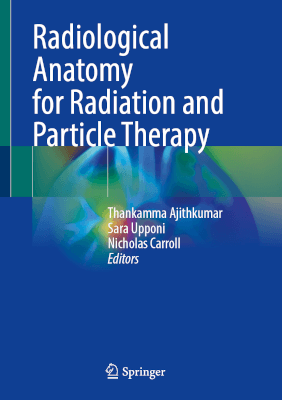
Radiological Anatomy for Radiation and Particle Therapy
Description
Provides practical solutions to common radiological anatomical challenges of target volume delineation.
Highlights methods for optimal integration of different imaging techniques for precise target delineation.
Offers tips on essential radiological anatomy for treatment verification.
Additional information
|
Author(s):
Ajithkumar, Upponi, Carroll | Ajithkumar, Upponi, Carroll |
|
ISBN:
978-3-031-48052-2 | 978-3-031-48052-2 |
|
Publisher:
Springer | Springer |
|
Reviewed by:
Dr Ruth McLauchlan, consultant radiotherapy physicist, Imperial College Healthcare NHS Trust, London | Dr Ruth McLauchlan, consultant radiotherapy physicist, Imperial College Healthcare NHS Trust, London |
Publisher price: £179.99
This is a publication recognising the increasing use of multimodality imaging in the planning and verification of radiotherapy treatments. The first four chapters give a comprehensive introduction to MR and PET imaging, although CT, described as the workhorse of radiotherapy planning, is given relatively little attention. Chapters five to 19 give tumour site-specific information and the volume concludes with chapters covering paediatric tumours and on-treatment verification.
Each chapter is written by different authors to provide expert knowledge in the specific topic. This leads to some inconsistencies in the presentation of material. Almost half the chapters include statements with no supporting references in the text. A further reading section is provided at the end, but it is not easy for the reader to link back to relevant material. There are several errors missed in the editorial process; the consistent replacement of ‘precession’ with ‘procession’ when describing the basics of MRI was irritating. There is some repetition between chapters, but this is useful, enabling a more practical use of the book, allowing the reader to dip in and out of sections.
Most of the chapters are directed at those involved in the planning rather than the delivery of treatment, but the chapter on anatomy for on-treatment verification was targeted at therapeutic radiographers and included a comprehensive discussion of the challenges faced when required to make timely decisions on patient positioning. A pragmatic approach was presented with the patient at the centre, focused on finding the right balance between efficiency and efficacy, risks and benefits. It is disappointing then that the chapter seems to be incomplete, with four subsections devoid of text and a subsection on artefacts being a short paragraph referencing some example images, which then ends abruptly with a short paragraph on the unrelated topic of audits.
However, a particular strength of this publication is the inclusion in most of the site-specific chapters of sections presenting the changes in anatomy that may be observed due to tumour spread and post-surgery/systemic treatment or radiotherapy. Generally, anatomy atlases used in radiotherapy planning departments only show normal anatomy, with very little on the effects of disease and nothing on the effects of treatment. This is particularly relevant considering the increasing number of cases of patients returning for further management. As a result, this is a book I will return to in my practice.
To purchase this title at our discounted rate email: katherine@radmagazine.com.