How clean is your lead apron?
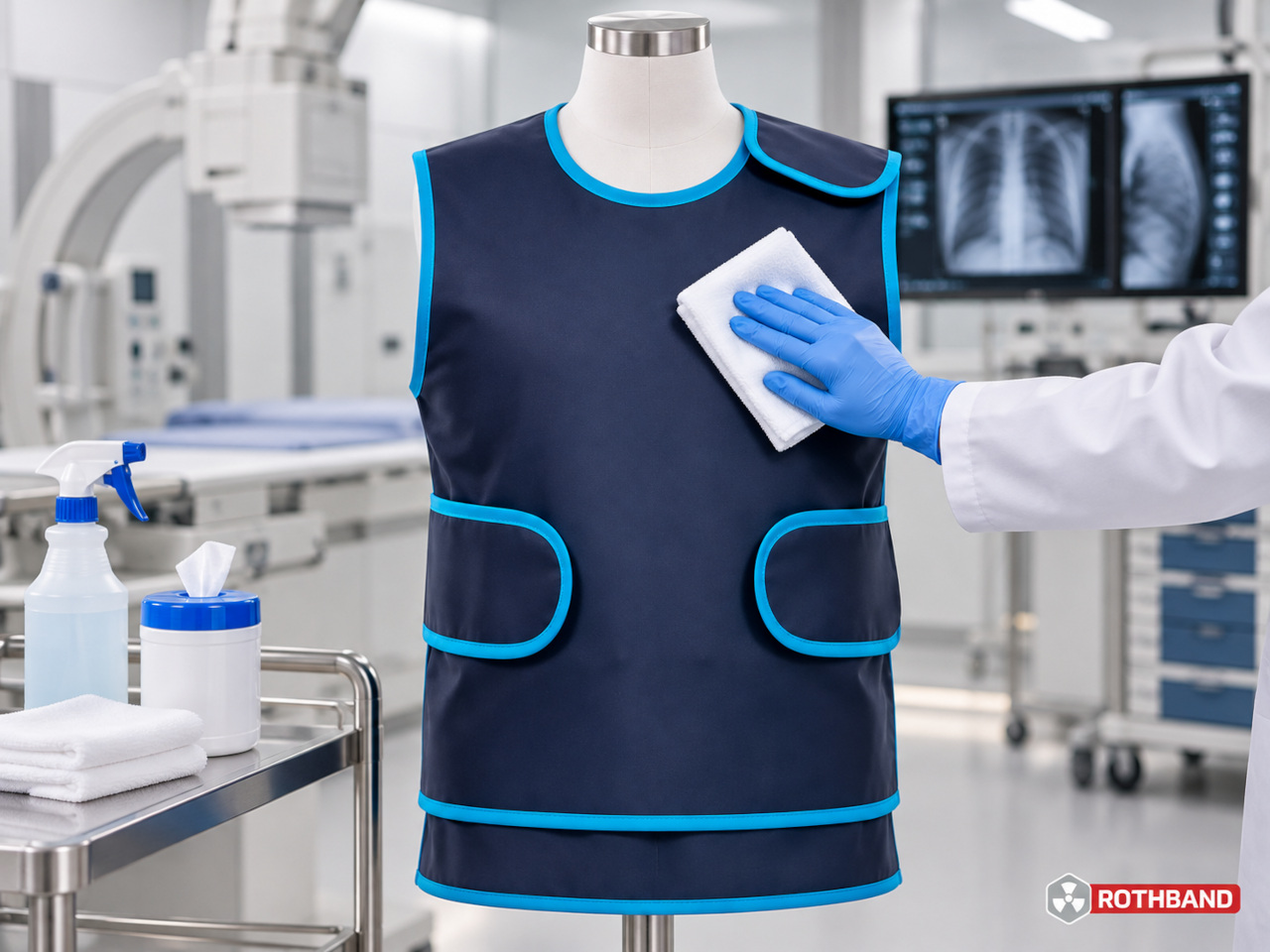
Ask anyone who has worked in theatre or a cath lab when their lead apron was last cleaned and you’ll often get a shrug. Aprons, vests and thyroid collars hang on a shared rack, go on and off several people in a shift, and sit inches from the sterile field.
They can’t go in the wash with the scrubs, so cleaning tends to mean a quick wipe when someone remembers. Over the past 15 years a handful of studies have looked at what that means in practice, and the findings are hard to ignore.
What the studies found
The first UK work came from Boyle and Strudwick in 2010. They swabbed 15 aprons in an imaging department in the east of England and found microorganisms on every single one, including Staphylococcus aureus and fungal spores.
A few years later, Jaber and colleagues sampled 25 aprons in an interventional radiology suite. 84% grew S. aureus or tinea, the fungus behind ringworm, and three of the S. aureus samples turned out to be MRSA.
In 2019, Jain’s team tested 20 theatre aprons using both standard culture and DNA-based testing. Bacteria showed up on 32 of 40 samples, and five aprons carried methicillin-resistant Staphylococcus epidermidis.
The largest study so far, published this year by Tong and colleagues, took 515 samples from garments in more than 150 operating rooms. Almost four in ten tested positive for blood that couldn’t be seen with the naked eye. On aprons and vests the figure was around 45%, three times the rate on neck shields.
Each team used different methods, so the numbers can’t be compared directly. The direction, though, was the same every time.
Why a wipe isn’t enough
Cleaning does help. Boyle and Strudwick showed that detergent and water cut contamination significantly, although the underside of the shoulders, where the apron rests against your scrubs, stayed dirtier than the front.
Jain’s results are the ones that stick. A hospital-grade disinfectant wipe cleared all culture growth and every trace of the resistant bacteria. Six hours later, two aprons were growing bacteria again and DNA testing was positive on 16 of the 20.
Blood is a different problem altogether. No disinfectant or cabinet physically lifts it off a garment, and dried soil can shelter the organisms underneath.
Getting it right
None of this needs a complicated fix. Check garments after use and wipe off any visible soil with a product the garment manufacturer has approved, because some disinfectants break down the outer fabric. Hang them on proper wide hangers with the fastenings open, and never fold them: creases crack the shielding underneath. Then disinfect regularly, including the parts a wipe can’t reach, and keep garments off open racks between lists.
That last step is where the Novven 3 comes in. Made in France by JVD and supplied in the UK by Rothband, it’s a cabinet that disinfects, dries and deodorises PPE using a controlled mix of ozone, temperature and time, with no water or chemicals. Because the treatment is carried by circulating air, it gets to the shoulder undersides and straps that hand cleaning tends to miss. A standard disinfection cycle takes 45 minutes. In independent testing to EN 17272:2020 by Eurofins Biolab, it cut every bacterial, viral and fungal strain tested by more than 99.999%. Garments can then stay in the closed cabinet until they’re needed. It won’t remove visible soil, so the wipe still matters, but it makes regular disinfection something that actually happens.
As always, follow your local infection prevention policy and the garment manufacturer’s instructions.
Sources
- Boyle H, Strudwick RM. Do lead rubber aprons pose an infection risk? Radiography 2010;16(4):297–303.
- Jaber M, Harvill M, Qiao E. Lead aprons worn by interventional radiologists contain pathogenic organisms including MRSA and tinea species. J Vasc Interv Radiol 2014;25(3 Suppl):S99–S100.
- Jain S, et al. Evaluation of bacterial presence on lead X-ray aprons utilised in the operating room via IBIS and standard culture methods. J Infect Prev 2019;20(4):191–196.
- Tong T, et al. Assessment of occult blood and bacterial contamination on protective lead garments in a tertiary hospital. Am J Infect Control 2026;54(7):815–817.
This news story has been sponsored by the companies concerned and does not represent the views or opinions of RAD Magazine.