The NHS doesn’t need another MRI scanner – it needs MRI that fits where patients are
When discussions turn to NHS MRI waiting lists, the conversation almost always centres on one solution: buy more scanners.
As someone working in MRI, I understand why. Demand for diagnostic imaging continues to rise, the population is ageing, and earlier diagnosis is rightly becoming a cornerstone of NHS strategy. More capacity is clearly needed.
But after years of discussions around capacity, estates and service delivery, I have become convinced that we are asking the wrong question.
Instead of asking how many MRI scanners the NHS needs, perhaps we should first ask whether we are putting MRI where patients actually need it.
For decades, MRI has been designed around the infrastructure of large acute hospitals. Heavy scanners, liquid helium, quench pipes, extensive shielding and major building works have made MRI installation one of the most complex and expensive diagnostic projects within healthcare.
That model made sense when almost all specialist diagnostics were delivered from large hospitals.
Healthcare, however, has changed.
Today, the NHS is working to bring diagnostics closer to patients through Community Diagnostic Centres, neighbourhood healthcare models and integrated care systems. The ambition is clear: improve access, reduce unnecessary hospital visits and diagnose patients earlier.
If healthcare is moving into the community, MRI should move with it.
The hidden barrier isn’t always scanner numbers
Across the UK there are countless locations where MRI could transform patient pathways.
Community hospitals.
Orthopaedic centres.
Sports medicine clinics.
Independent treatment centres.
Retail healthcare environments.
Many of these locations already see high volumes of musculoskeletal patients, yet they continue referring them to acute hospitals because conventional MRI systems simply demand too much infrastructure.
The consequences are familiar.
Patients travel further than necessary.
Hospital MRI departments become increasingly congested.
Routine musculoskeletal examinations compete for appointments alongside complex neurological, oncological and abdominal imaging.
The limiting factor is often not scanner demand.
It is infrastructure.
It’s time to rethink low-field MRI
Historically, low-field MRI has often been viewed as a compromise.
Lower installation costs and greater patient accessibility were acknowledged, but image quality and scan times were frequently compared against high-field systems.
That perception no longer reflects modern MRI.
Artificial intelligence has fundamentally changed what low-field MRI can achieve.
Advanced AI reconstruction algorithms are now capable of reducing noise, improving spatial resolution and enhancing anatomical detail while simultaneously shortening acquisition times. Instead of viewing low-field MRI as an alternative to high-field imaging, it should increasingly be recognised as a complementary technology designed for the examinations where it delivers the greatest clinical and operational value.
For specialist musculoskeletal imaging, this represents a significant shift.
The combination of dedicated MSK hardware, optimised imaging sequences and AI-enhanced reconstruction now enables low-field MRI systems to deliver excellent diagnostic performance while improving patient throughput.
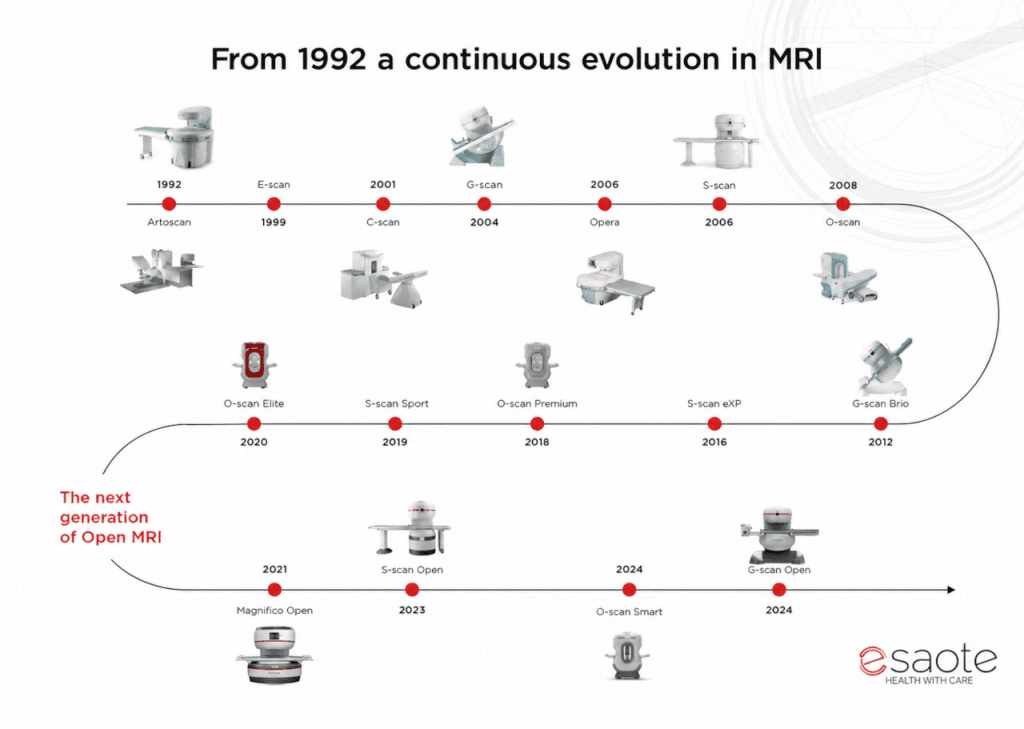
Technologies such as Esaote’s E-Spades demonstrate how AI can bridge much of the historical gap between low-field and high-field imaging. By enhancing image quality while reducing scan times, departments can increase diagnostic confidence, improve productivity and scan more patients without compromising clinical performance.
Rather than asking whether low-field MRI is “good enough”, perhaps we should now be asking whether it is the most appropriate technology for a significant proportion of routine MRI examinations.
Infrastructure should no longer dictate access
Perhaps the greatest advantage of modern low-field MRI lies beyond image quality.
It is the freedom to install MRI where patients actually need it.
Cryogen-free dry magnet technology removes many of the infrastructure challenges that have traditionally limited MRI deployment. Without liquid helium, quench pipes or extensive structural requirements, specialist MRI systems can often be installed in locations previously considered unsuitable for MRI.
This creates opportunities to deliver imaging within Community Diagnostic Centres, orthopaedic practices, independent providers and community healthcare settings, bringing MRI significantly closer to patients.
The benefits extend beyond accessibility.
Cryogen-free technology reduces dependence on helium, one of healthcare’s increasingly vulnerable global resources. It lowers energy consumption, simplifies installation and supports the NHS’s long-term sustainability ambitions while reducing the cost and complexity of expanding MRI capacity.
Expansion should no longer be constrained by whether a building can accommodate a conventional scanner.
Instead, healthcare planners should be asking where patients would benefit most from local MRI access.
The right scanner for the right examination
Not every MRI examination requires a 1.5T or 3T whole-body scanner.
A significant proportion of NHS MRI demand consists of musculoskeletal imaging including knees, shoulders, ankles, feet, hands and wrists.
These examinations are often performed on the same scanners used for complex neurological, cardiac and oncology imaging, despite having very different clinical requirements.
Creating dedicated musculoskeletal MRI pathways using specialist low-field systems allows healthcare providers to deliver routine imaging closer to patients while releasing valuable capacity on high-field scanners for more complex examinations.
This is not about replacing high-field MRI.
It is about deploying the right technology for the right patient pathway.
Healthcare has already embraced this philosophy elsewhere.
Elective surgery is increasingly delivered in specialist centres.
Minor injuries are managed outside major trauma units.
Diagnostics should follow exactly the same principle.
Looking beyond field strength
For decades, MRI has largely been judged by one specification: magnetic field strength.
The future of diagnostic imaging will be defined by something much broader.
Access.
Efficiency.
Sustainability.
Clinical outcomes.
The ability to deliver high-quality imaging where patients actually need it.
Low-field MRI is no longer simply about smaller scanners.
With advances in AI reconstruction, specialist musculoskeletal optimisation and cryogen-free technology, it has become an increasingly important part of the solution to expanding MRI capacity sustainably across the NHS.
The NHS undoubtedly needs continued investment in MRI.
But success should not simply be measured by how many scanners we buy.
It should be measured by how quickly patients can access imaging, how intelligently we use our hospital estates, and how effectively new technology allows diagnostics to move beyond the walls of acute hospitals.
Perhaps the NHS doesn’t simply need more MRI scanners.
Perhaps it needs MRI that finally fits where patients are.
The content on this page is provided by the individuals concerned and does not represent the views or opinions of RAD Magazine.