Singleton Hospital staff invest time and effort to make GE StarGuide SPECT/CT implementation a success
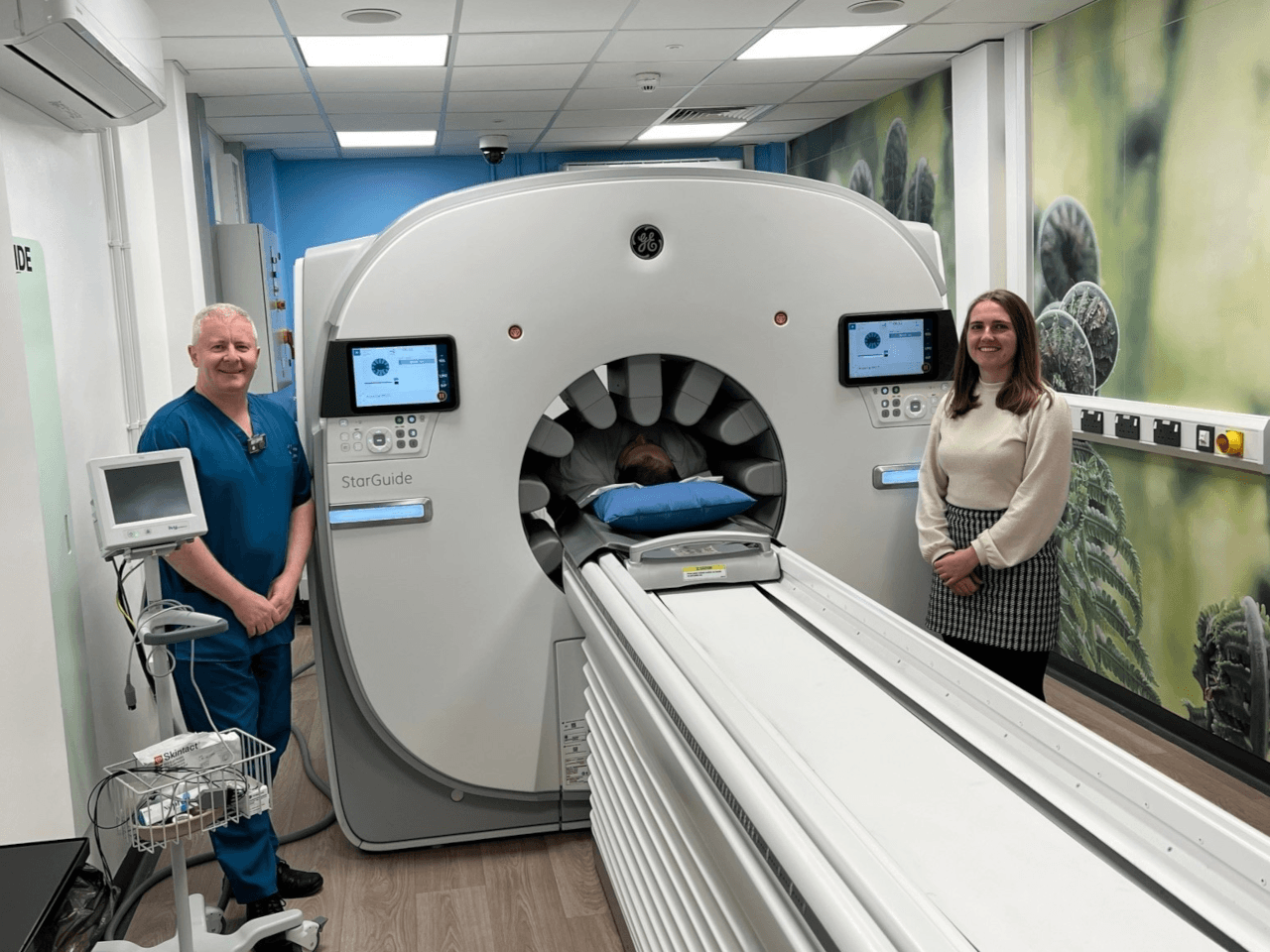
Singleton Hospital, part of NHS Wales’ Swansea Bay University Health Board, installed the UK’s first GE HealthCare StarGuide gamma camera in early 2022. StarGuide is a CZT ring detector gamma camera for SPECT/CT imaging, said to offer increased signal-to-background ratios, increased contrast-to-noise ratios, better lesion detectability and better lesion delineation.
The acceptance testing of this system was a learning curve for the Singleton team, as testing regimes for traditional NaI scanners do not directly apply. Due to the scanner’s geometry, with no planar imaging capability and fixed tungsten collimation, it was not possible to perform all commissioning tests following NEMA Testing Standards. ‘Planar’ testing was only relevant as a means to test the capability of each detector head, and intrinsic tests were not possible or relevant. The team reports that energy resolution, sensitivity and SPECT spatial resolution values demonstrated were excellent. “The only area for concern was detector uniformity using 99mTc, but the 99mTc SPECT uniformity was demonstrated to be equivalent to that of traditional NaI systems in the area, which was reassuring.”
As the scanning is 360°, there is no need for additional imaging of patients and acquisition times are lower, reducing occurrences of sessions overrunning and increasing throughput. Set up for scans is said to be simple and they are well tolerated by patients, with no observable increase in claustrophobia. Established scanning protocols are used for whole body SPECT/CT bone scans, myocardial perfusion scans, brain dopamine transporter studies, parathyroid imaging, and lung ventilation and perfusion scans. A local normal database has been developed for myocardial perfusion scans, as existing databases only contain NaI scans and do not account for the increased image quality. A calibration factor has been derived to compare brain dopamine transporter studies to a European normal database, and population outcomes since implementation have been comparable between the StarGuide and the site’s NaI camera.
“The clinical implementation of the UK’s first GE StarGuide scanner at Singleton Hospital has been highly successful, having performed over 2,000 clinical studies since installation,” the Singleton team concludes. “All nuclear medicine staff have had to develop knowledge and skills, and have invested significant time and effort in protocol development and optimisation to best utilise this new technology.”
Picture: Chief clinical technologist John Lewis and clinical scientist Christine Turner with the GE StarGuide.
Read this report on page 4 of the April 2025 issue of RAD Magazine.