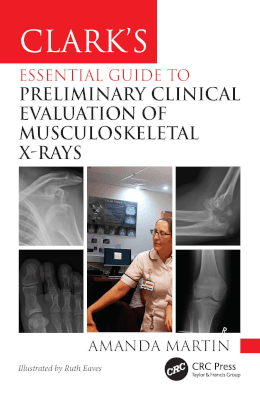
Clark’s Essential Guide to Preliminary Clinical Evaluation of Musculoskeletal X-rays
Additional information
|
Author(s):
Martin | Martin |
|
ISBN:
978-1-032-83292-0 | 978-1-032-83292-0 |
|
Publisher:
CRC Press, Taylor & Francis | CRC Press, Taylor & Francis |
|
Reviewed by:
Lisa Field, consultant radiographer, clinical lead DXA service and radiology osteoporosis lead, Mid Yorkshire Teaching NHS Trust; associate lecturer, University of Derby | Lisa Field, consultant radiographer, clinical lead DXA service and radiology osteoporosis lead, Mid Yorkshire Teaching NHS Trust; associate lecturer, University of Derby |
Publisher price: £31.99
It was a pleasure to review this textbook, which advocates for diagnostic radiographers’ involvement in the preliminary clinical evaluation (PCE) of image appearances, helping to inform patient treatment and management. For readers unfamiliar with PCE, the preface perfectly defines it with reference to the framework document by The Society and College of Radiographers.
The book is laid out in a clear format, with the text split into seven sections.
The introduction includes information regarding normal variants and the approach to identifying these. Chapter one covers good governance, providing information on how to implement PCE safely with an agreed scope of practice, and the legal differences between a formal report and PCE.
Section two covers upper limb trauma. Each anatomical section starts with information on the expected mechanism of trauma and how this relates to the typical abnormality/fracture appearances.
In section three, covering lower limb trauma, there are good examples of a comment clearly labelled next to each image, which is good for improving the reader’s confidence in constructing a comment and improving pattern recognition skills.
The diagrams and illustrations are excellent in section four, covering axial trauma, which gets across explanations and demonstrations to the reader in an uncomplicated manner.
Section five covers the radiological signs of abuse, a very important topic that is really well described and set out in a reader-friendly manner.
The sixth section on pathological findings within the musculoskeletal system is a whistle-stop tour of the most common non-traumatic findings, giving the radiographer confidence in providing a comment.
Section seven offers an opportunity for the reader to practice PCE with some example cases. Each one includes the evaluation of the image using the ABCS method [alignment, bone texture, corticals and soft tissues] and covers how to interpret these findings and construct a comment for the referrer.
Radiographers are one of the first healthcare professionals to see a patient’s images, and they should have the confidence and ability to identify signs of abuse and abnormality in order to safeguard and improve the patient’s management. Ultimately, this book is an excellent resource and will help diagnostic radiographers to have a direct impact on improving patient outcomes.
To purchase this title at our discounted rate email: katherine@radmagazine.com.