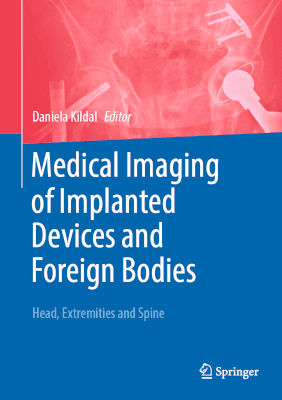
Medical Imaging of Implanted Devices and Foreign Bodies: Head, Extremities and Spine
Description
Correct recognition and location of foreign bodies.
Schematic drawings for regular position and misalignments.
Everything that the specialist at the workplace needs.
Additional information
|
Author(s):
Kildal | Kildal |
|
ISBN:
978-3-662-65448-4 | 978-3-662-65448-4 |
|
Publisher:
Springer | Springer |
|
Reviewed by:
Dr Samantha Mills, consultant neuroradiologist, The Walton Centre NHS Foundation Trust | Dr Samantha Mills, consultant neuroradiologist, The Walton Centre NHS Foundation Trust |
Publisher price: £179.99
The concept of this book is simple. The majority of it focuses on providing an overview of implanted medical devices such as drug pumps, clips, coilings, prostheses and neurostimulators, with explanations of the function of the devices and how they appear on imaging. While this has some value for clinically active radiologists and radiographers, it should be noted that the implanted device market is continually evolving and new devices are being released into clinical practice all the time. This book has been translated from a German edition, which was published in 2017, thus all the examples of implanted devices within the text are at least eight years old and many will have been superseded by newer devices.
Section I gives an overview of potential imaging artefacts due to medical devices on plain film, CT and MRI. It also details the procedure for examining patients with implants in MRI and details a list of devices which are reported to be contraindicated for MRI. This is misleading and factually incorrect as a number of these devices can be imaged safely when using the correct settings with modifications to MRI acquisitions. Readers should be advised to seek out up-to-date MRI safety instructions specific to the devices (both make and model) that are implanted in the patient on a case-by-case basis.
Sections II to IV provide a comprehensive and conventional overview of medical procedures and devices, a proportion of which are still in use today and therefore this has some current clinical value. Section V is interesting, in a rather more curious way, covering accidental and traumatic foreign bodies. The clinical value of this section is limited, and I wonder whether this has been provided more for entertainment rather than education, particularly given an entire subsection is devoted to autoerotic foreign bodies. The additional annotations provided on some of the figures are unnecessary.
I would not recommend this text. If you require information on whether a device is safe for MRI scanning, the most up-to-date information is required from the manufacturer and this book will not help you. Regarding the imaging appearances of all other medical devices, this information is widely and freely available from the manufacturers and other radiology websites.
To purchase this title at our discounted rate email: katherine@radmagazine.com.