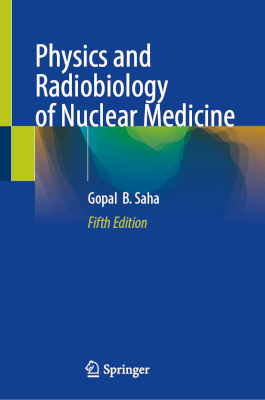
Physics and Radiobiology of Nuclear Medicine, fifth edition
Description
Fully updated with two new chapters on AI;
Encompasses major topics in nuclear medicine;
Ideal for Board and Registry exams.
Additional information
|
Author(s):
Saha | Saha |
|
ISBN:
978-1-0716-4815-5 | 978-1-0716-4815-5 |
|
Publisher:
Springer | Springer |
|
Reviewed by:
Dr Heather Williams, consultant medical physicist, clinical director, medical physics and engineering, The Christie NHS Foundation Trust, Manchester | Dr Heather Williams, consultant medical physicist, clinical director, medical physics and engineering, The Christie NHS Foundation Trust, Manchester |
Publisher price: £109.99
Physics and Radiobiology of Nuclear Medicine was first published in 1993, primarily the work of Gopal Saha of the Cleveland Clinic in
Ohio. The fifth edition is a light-touch review of the 2013 edition, plus two additional chapters on AI.
Overall, the book provides a comprehensive introduction to the physics and radiobiology of nuclear medicine, clearly written and well
referenced. The text is neatly formatted and liberally illustrated with relevant figures, all of which are of good quality and many of which
are in colour. Each chapter also includes a series of questions to test the reader’s understanding and suggested further reading, a useful
feature that positions the book as a study guide as well as a reference text.
Chapters one to four and six cover the structure of matter, radioactive decay and its kinetics, the statistics of radiation counting and
interaction of radiation with matter – areas of fundamental physics that have not changed over this period.
Chapters five and seven to 13 cover production of radionuclides, gas-filled, scintillator and semiconductor detectors, the gamma
camera, SPECT and PET. These chapters would have benefitted from a more thorough review as some new developments in radioisotope
production and detector technology are noticeable by their absence and obsolete technology is still included; the detailed discussion of
digital computers feels particularly unnecessary and outdated.
Chapters 14 and 15 endeavour to cover AI in nuclear medicine over 40 pages, so only provide a very limited detail in contrast to earlier
chapters on fundamental physics. There is still much here that is helpful, particularly the description of different AI techniques and a
short glossary, but other sections feel too brief, and it is disappointing that there is specific mention of ChatGPT but not more medicallyfocused
solutions.
Chapters 16 to 18 cover internal dosimetry and radiation biology, with chapter 18 covering radiation protection and regulations. Given
the title, the book feels somewhat unbalanced with only two chapters on radiobiology. It is also worth noting that the radiation
protection chapters are very USA-focused in terms of legislation and terminology.
In summary, this book remains an authoritative text on the subject, but the improvements provided in the fifth edition are modest.
Anyone owning the fourth edition should not feel compelled to purchase the fifth. It should be hoped that the sixth edition involves a
more comprehensive review of content and expansion of sections on image reconstruction and analysis, including using AI.
To purchase this title at our discounted rate email: katherine@radmagazine.com.