Next generation theranostic pair offers new strategy to detect and treat metastatic kidney cancer
A newly developed radiotheranostic pair, 68Ga/177Lu-NYM096, can identify tumors and effectively deliver targeted radiotherapy to patients with metastatic clear cell renal cell carcinoma (ccRCC). Using a small molecule compound, the new approach helps to mitigate toxicity issues common with treatment, offering a safe and feasible strategy for those with end-stage disease. This research was published in the September issue of The Journal of Nuclear Medicine.
ccRCC is the most common subtype of renal cancer, accounting for approximately 70 to 80 per cent of all cases. Many patients have unresectable or metastatic disease upon initial diagnosis or develop advanced-stage disease after initial localized treatment. While immunotherapy-based combination therapies have emerged as effective treatment strategies, a notable proportion of patients don’t respond to therapy or experience significant toxicities.
“My colleagues and I developed a new generation of small molecule compounds that target carbonic anhydrase IX (CAIX) enzymes which are overexpressed in ccRCC,” said Wenjia Zhu, MD, associate professor in the department of nuclear medicine at Peking Union Medical College Hospital in Beijing, China. “These compounds allow for radiolabeling with both diagnostic and therapeutic radioisotopes to more precisely, and safely, deliver treatment to patients.”
Researchers conducted preclinical and first-in-human experiments to explore the characteristics of the theranostic pair 68Ga/177Lu-NYM096, focusing on its safety, tolerability, dosimetry, and preliminary efficacy for metastatic ccRCC. First, in vivo biodistribution of 68Ga-NYM096 and the therapeutic efficacy of 177Lu-NYM096 was evaluated in ccRCC-tumor bearing mice. Next, patients with metastatic ccRCC who had disease progression after standard therapy underwent serial whole-body 68Ga-NYM096 PETCT to evaluate biodistribution and dosimetry. Those with positive CAIX expression received 177Lu-NYM096 following a standard 3-plus-3 dose escalation design. Serial whole body planar imaging was performed after the first therapy cycle. Safety, dosimetry, and preliminary efficacy were evaluated.
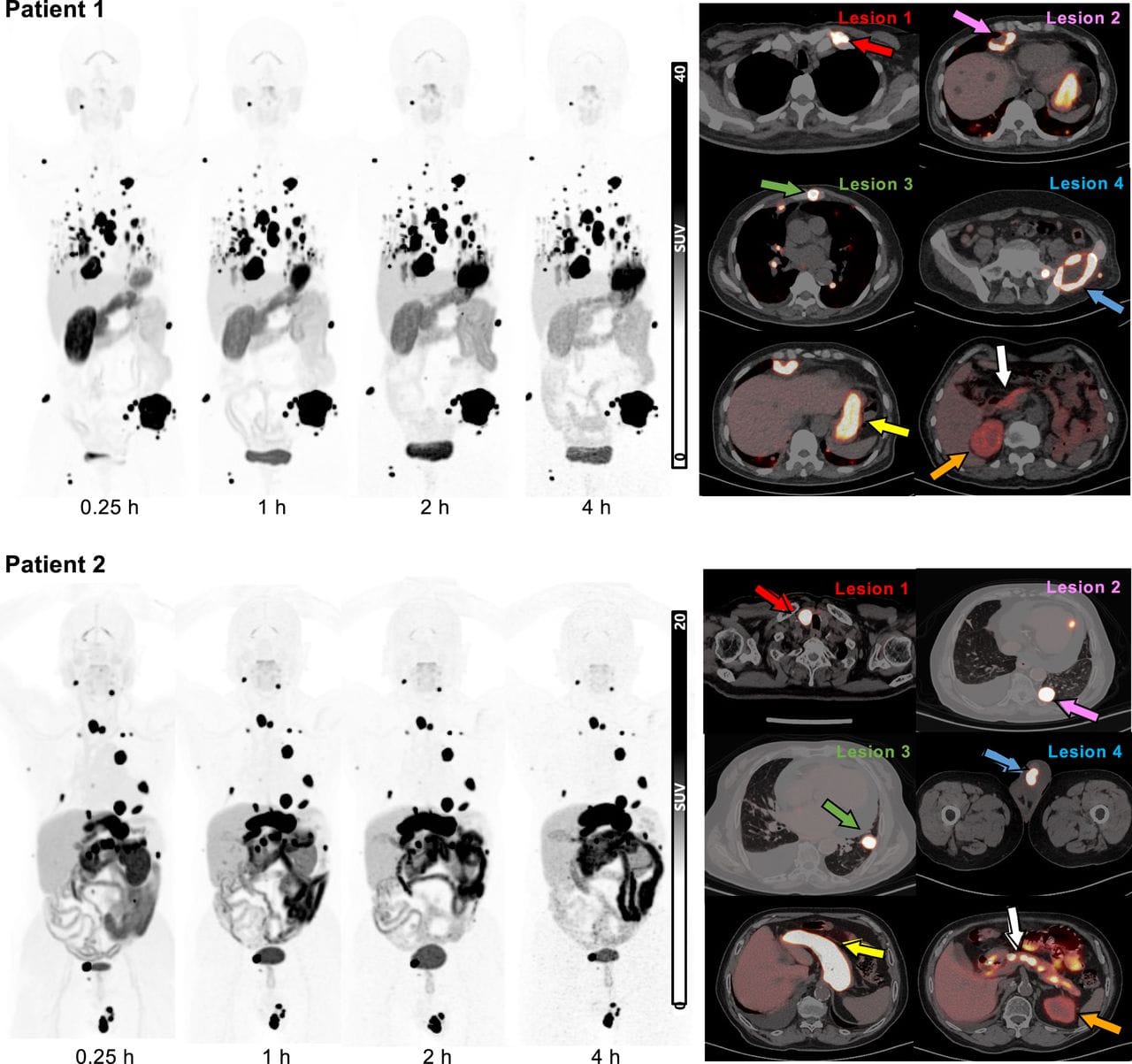
In the murine models, high tumour accumulation of 68Ga/177Lu-NYM096 was observed. 177Lu-NYM096 was well tolerated and demonstrated a significant dose-dependent tumour suppression effect. In patients, 68Ga-NYM096 demonstrated excellent tumour uptake and 177Lu-NYM096 treatment demonstrated no evidence of nephrotoxicity, hepatotoxicity, or pancreatic toxicity. Gastric toxicity, however, was observed. Follow-up 68Ga-NYM096 PETCT evaluations showed evidence of tumor response to 177Lu-NYM096 treatment.
“Our imaging agent identified tumours with very high uptake, and our early clinical experience suggests that targeted radiotherapy may offer a new treatment strategy for selected patients,” noted Li Huo, MD, director of the department of nuclear medicine at Peking Union Medical College Hospital in Beijing, China. “This study provides the first human evidence of both the promise of this approach and highlights an important challenge – radiation to the stomach – that will help guide the development of safer future treatments.”
Figure: Serial whole-body maximum-intensity projections over time and representative transaxial images at one hour post-injection of 68Ga-NYM096. Substantial CAIX expression was observed in multiple metastatic lesions, including bone, lung, lymph nodes, muscle, pleura, and thyroid of patient 1 and lung, lymph nodes, muscle, bone, thyroid, pancreas, pericardium, atrial septum, peritoneum, and testis of patient 2. Physiologic uptake was observed in stomach wall (yellow arrows), kidney (orange arrows), and pancreas (white arrows). Multiple metastatic lesions were also observed in pancreas of patient 2.
Source: SNMMI.
The authors of “Preclinical and First-in-Human Study of Carbonic Anhydrase IX–Targeting Theranostic Pair, [68Ga]Ga/[177Lu]Lu-NYM096, in Clear Cell Renal Cell Carcinoma” include Jingnan Wang, Xinchun Yan, Meixi Liu, Xueqian Yang, Wenjia Zhu, and Li Huo, Department of Nuclear Medicine, Beijing Key Laboratory of Molecular Targeted Radiopharmaceutical Development and Translational Application, Peking Union Medical College Hospital, Chinese Academy of Medical Sciences and Peking Union Medical College, Beijing, China; Guoyang Zheng and Yushi Zhang, Department of Urology, Peking Union Medical College Hospital, Chinese Academy of Medical Sciences and Peking Union Medical College, Beijing, China; and Xiaoyuan Cheng and Chunmei Bai, Department of Oncology, Peking Union Medical College Hospital, Chinese Academy of Medical Sciences and Peking Union Medical College, Beijing, China.
The content on this page is provided by the individuals concerned and does not represent the views or opinions of RAD Magazine.