Lumora offers a point-of-care alternative to 3D-printed bolus
Custom bolus solutions have become more common in radiotherapy practice, particularly as departments seek improved conformity to anatomy and greater dosimetric accuracy for superficial targets, says CDR Systems, which produces Lumora mouldable bolus material. Additive manufacturing has enabled production of patient-specific bolus devices based on CT simulation data, providing an alternative to sheet bolus materials, the company explains.
While 3D-printed bolus offers advantages in anatomical customisation, the workflow required to produce these can introduce challenges for radiotherapy departments. Segmentation, contouring, STL file generation, printer scheduling, manufacturing, post-processing and QA all add to the process. One approach is the use of point-of-care (POC) bolus materials, such as Lumora, that can be customised in the radiotherapy department.
POC bolus solutions allow clinicians to shape and adapt a patient-specific bolus to the treatment area during simulation or treatment preparation. This shifts production from a multi-step process to a clinical procedure performed at the POC or as soon as bolus is prescribed. It can be moulded directly over a patient or onto an immobilisation mask. Instead of waiting for additive manufacturing workflows to complete, the clinical team can evaluate and refine bolus fit immediately. In busy centres where scheduling pressures are common, says CDR, reducing delays between simulation and treatment can improve workflow efficiency while maintaining the flexibility needed for complex patient cases.
In typical clinical use, a patient-specific Lumora bolus can be prepared in approximately eight minutes. It is engineered to reduce air gaps and improve conformity across irregular anatomical surfaces, particularly in areas where traditional sheet bolus materials can be difficult to apply and where 3D-printed or custom wax bolus solutions have traditionally been used.
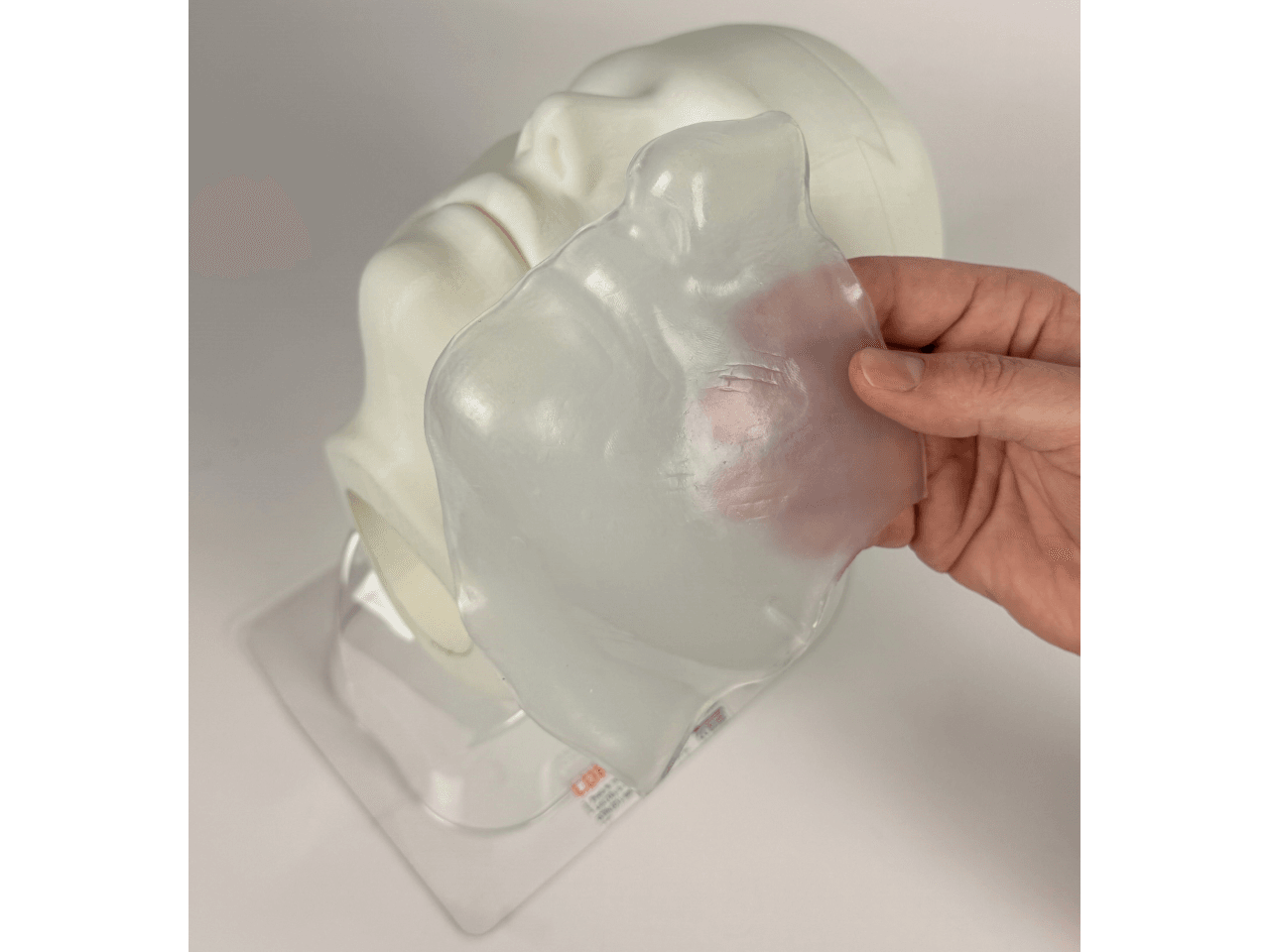
Picture: A custom bolus can quickly provide a 3D-printed level of conformity.
Read this report on page 18 of the April 2026 issue of RAD Magazine.