Radiobotics and Oxford University Hospitals NHS Foundation Trust launch the UK’s first — and world’s largest — randomised controlled trial of AI-assisted fracture detection in the ED

At the heart of the project is a single, crucial question: can the use of AI reduce the number of unnecessary patient contacts within the NHS?
Radiobotics is proud to announce that its collaboration with Oxford University Hospitals NHS Foundation Trust (OUH) has received official approval to begin the UK’s first – and world’s largest — randomised controlled trial of AI-assisted fracture detection in the ED.
The study — titled SAMURAI Pro (Systematic Assessment of the Medical Utility of Radiology Artificial Intelligence – Prospective Evaluation) Fracture Detection — will evaluate the real-world impact of implementing Radiobotics’ AI-powered fracture detection solution, RBfracture, in clinical workflows.
The work is being carried out under the umbrella of OxCAIR (Oxford Clinical Artificial Intelligence Research) and supported by SBRI Healthcare Competition 26, an NHS England Accelerated Access Collaborative initiative focused on improving the delivery of timely and urgent emergency care.
The SAMURAI Pro – Fracture Detection study fills a key gap in the evidence generation plan for the NICE — a UK national framework that evaluates promising technologies — Early Value Assessment for AI Technologies to Help Detect Fractures on X-rays in Urgent Care (published January 2025).
What is the value of AI in the ED or emergency medicine?
At the heart of the project is a single, crucial question: can the use of AI reduce the number of unnecessary patient contacts within the NHS?
Radiobotics has already proven that RBfracture has reduced the number of missed fractures in an NHS A&E by 86%, with an accuracy, specificity, and sensitivity of 94% and a median processing time of 15 seconds per exam.
However, this collaboration aims to go beyond conventional performance studies to deliver evidence of AI’s real-world effect on workflows, patient care, and healthcare resources. The study will measure whether RBfracture can reduce avoidable follow-ups or delays in care by enabling faster, more accurate decision-making in the emergency setting.
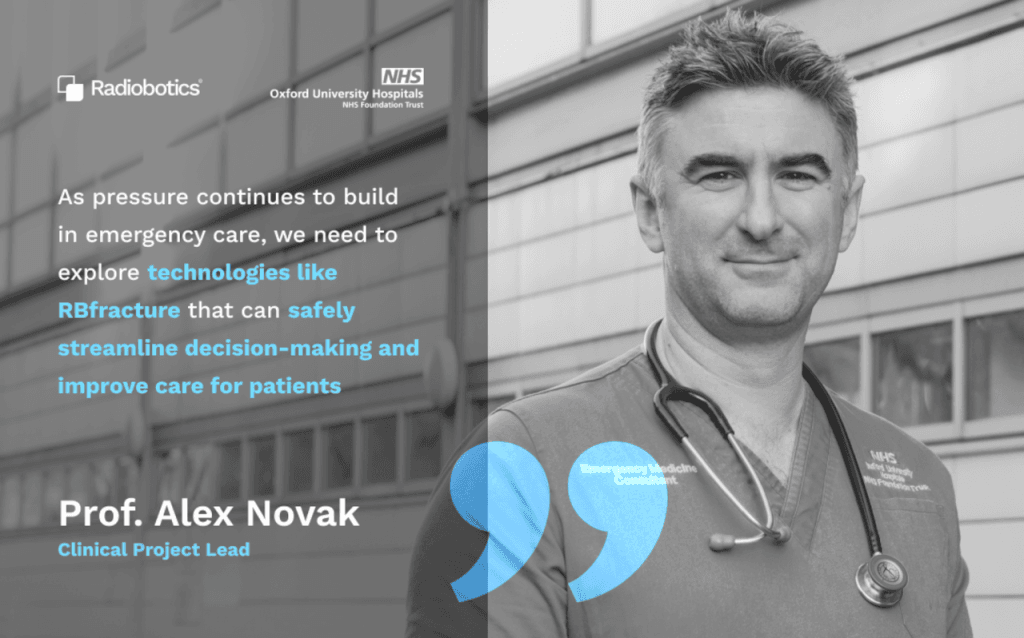
“We’re excited to begin this important study in collaboration with Radiobotics. As pressure continues to build in emergency care, we need to explore technologies like RBfracture that can safely streamline decision-making and improve care for patients,” says Professor Alex Novak, clinical project lead, OxCAIR, Oxford University Hospitals NHS Foundation Trust.
The project will employ a prospective cluster randomised cross-over trial — a robust study design in which different hospital sites or departments will switch between using RBfracture and standard care at different times. This allows researchers to fairly compare the two approaches and understand RBfracture’s practical benefits across diverse settings.
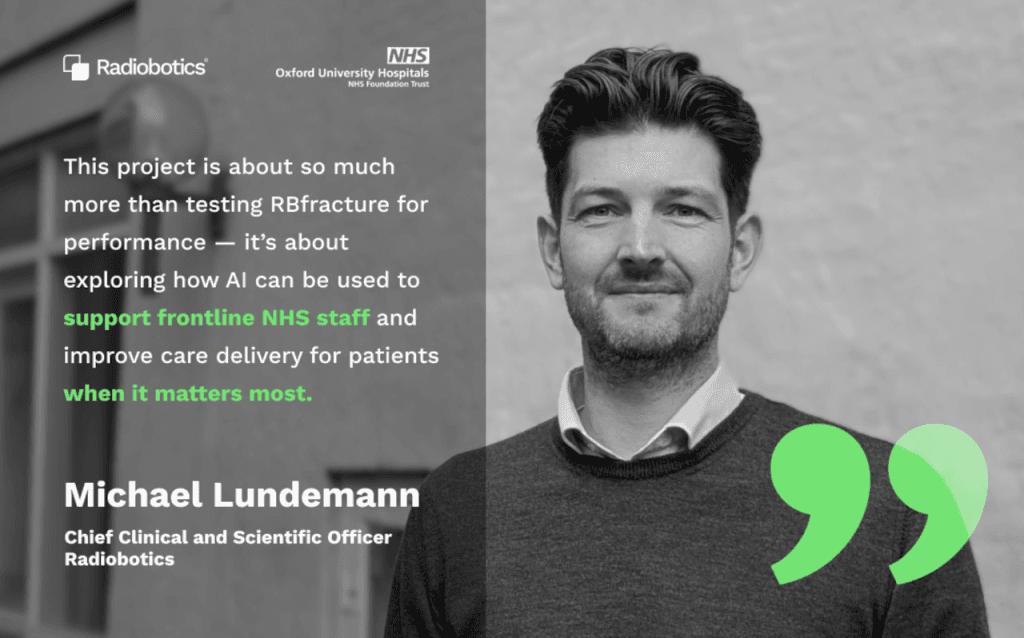
“We’re thrilled to officially move forward with this important work,” said Michael Lundemann, chief clinical and scientific officer at Radiobotics. “This project is about so much more than testing RBfracture for performance — it’s about exploring how AI can be used to support frontline NHS staff and improve care delivery for patients when it matters most.”
The SAMURAI project also closely aligns with broader UK Government priorities, including:
- Ensuring the NHS has the right tools and workforce when and where patients need them,
- Reducing lives lost to major health threats through faster, smarter interventions, and
- Creating a fairer healthcare system where everyone can live well for longer.
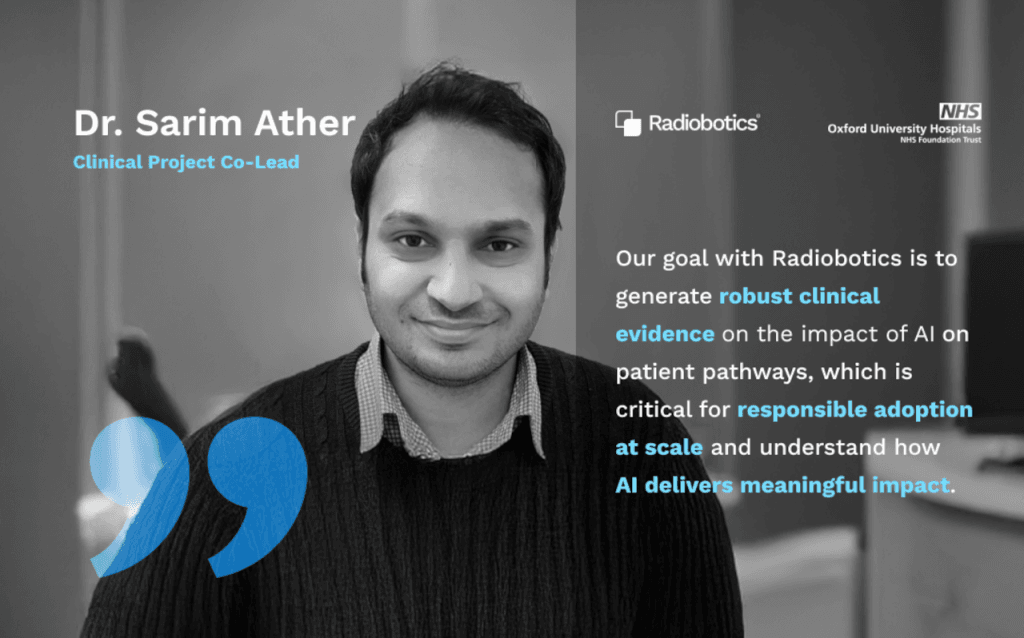
Dr Sarim Ather, clinical project co-lead, adds: “Our goal is to generate robust clinical evidence on the impact of AI on patient pathways, which is critical for responsible adoption at scale and understand how AI delivers meaningful impact.”
With the green light now given, Radiobotics and OUH are ready to begin implementation.
This news story has been sponsored by the companies concerned and does not represent the views or opinions of RAD Magazine.