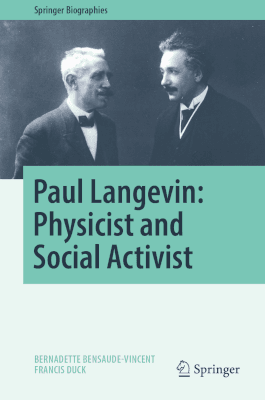
Paul Langevin: Physicist and Social Activist
Description
Places Langevin’s contributions in relativity, electron physics and magnetism into an international historical context.
Examines Langevin’s actions for social justice and educational equity at a time of rising fascism.
Establishes Langevin as the originator of ultrasonics, at the root of medical ultrasonics.
Additional information
|
Author(s):
Bensaude-Vincent and Duck | Bensaude-Vincent and Duck |
|
ISBN:
978-1-965534-05-2 | 978-1-965534-05-2 |
|
Publisher:
Springer | Springer |
|
Reviewed by:
Professor Adrian Thomas, visiting professor, Canterbury Christ Church University | Professor Adrian Thomas, visiting professor, Canterbury Christ Church University |
Publisher price: £38.99
Francis Duck has done us a service with his work on the French physicist Paul Langevin (1872-1946). Duck is a retired medical physicist, with a lifelong interest in ultrasound and the history of physics.
Until recently there has been little in English literature about Langevin. Duck has added significantly to it and this is very helpful. Some years ago, Duck translated and edited an edition of Paul Langevin, My Father: The Man and His Work (EDP Sciences, 2022), a biography by André Langevin of his father. This was an important work with many personal insights. André, who died in 1977, was the second son of Paul Langevin and was himself a student of physics. He shared his father’s political interests and was also a communist activist.
This book is a translation of the 1987 biography by Bernadette Bensaude-Vincent, Langevin: 1872-1946, Science et Vigilance. Bernadette Bensaude-Vincent has written on the history of science and philosophy. This new book adds significantly to the original text and includes new figures and descriptions. As might be expected from Duck’s interests, the section on ultrasound has been significantly developed and expanded.
Paul Langevin was a student of Pierre Curie, and a close friend of Marie Curie and Albert Einstein. He can be seen as one of the group of influential European physicists who created, at the beginning of the 20th century, what became modern physics and transformed our understanding of the nature of reality. Scientifically, he made contributions to the atomic theory of magnetism and to the understanding of relativity and statistical kinetics. We now know him as the ‘originator of modern ultrasonics’ during the Great War, and for his influence on the growth of ultrasound as a scientific speciality during the following two decades.
As an educationalist, Langevin was an advocate of education for women, and for science as a core subject in schools. Langevin viewed science as a common good, and that the knowledge acquired should be shared for the benefit of all of humanity at a time of growing nationalism in the 1930s. The authors focus on his political activism as a rationalist and humanist, including his public anti-fascist stand and communist sympathies which resulted in his house arrest during the Second World War.
The contributions that a committed scientist can make are particularly relevant today. Anyone interested in ultrasound will benefit from reading this biography.
To purchase this title at our discounted rate email: katherine@radmagazine.com.