The impact on human factors and workforce: experiences from AI lung cancer work and beyond
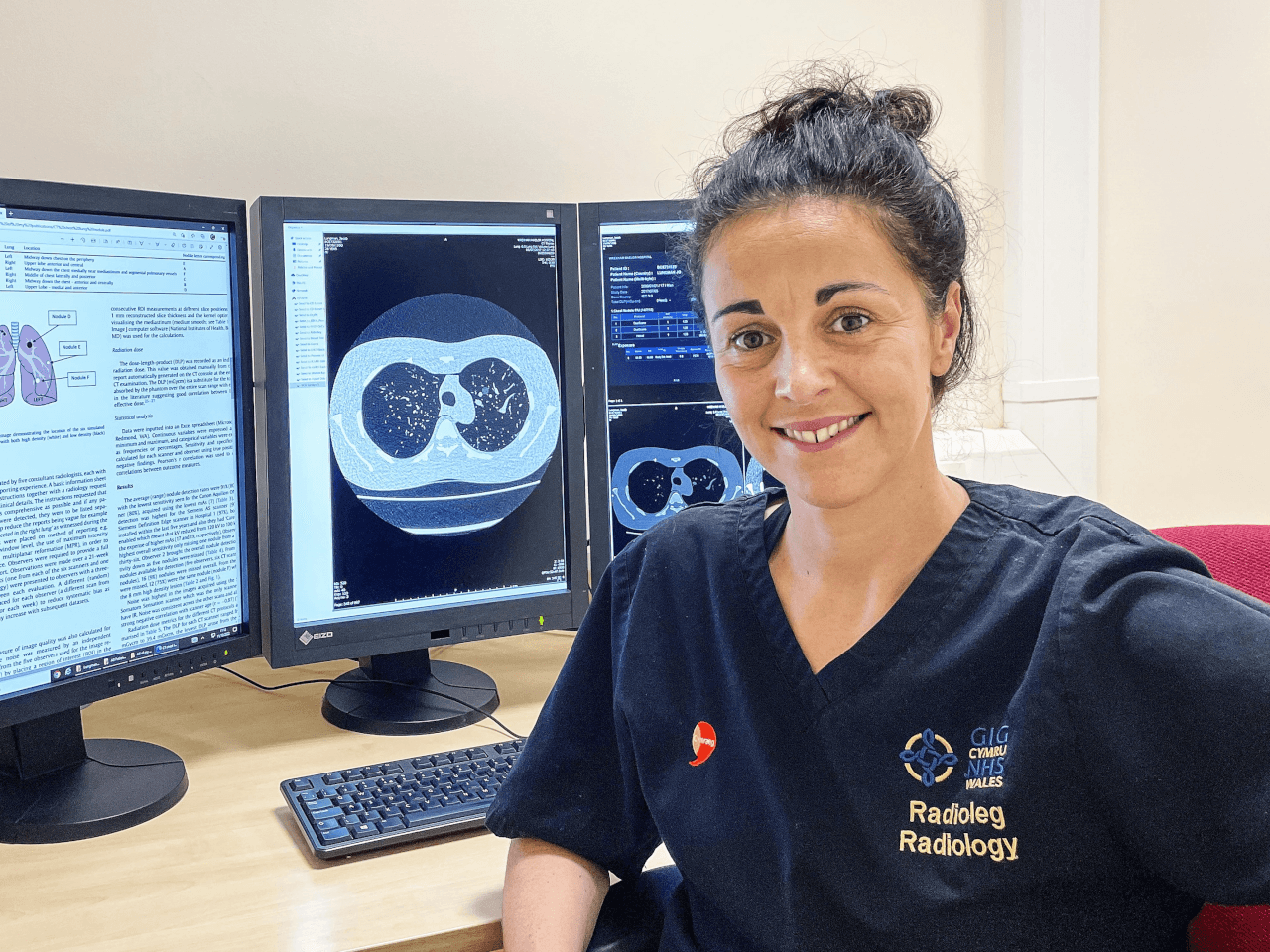
Dr Jenna Allsup is a research radiographer based at Betsi Cadwaladr University Health Board in North Wales, supported by Health and Care Research Wales, and an honorary lecturer at the College of Medicine and Health, Bangor University. Her studies include a randomised controlled trial exploring alleviating MRI anxiety; supporting the National COVID-19 Chest Imaging Database; MRI in ovarian cancer; and the MIDI trial, examining whether an AI tool can identify abnormalities on MRI head scans. She has contributed to Health and Care Research Wales initiatives including development of national patient and public involvement resources, supporting clinical academic guidance and participation in grant panel peer review.
Dr Allsup is currently writing two papers from her recent All Wales AI automation bias study, which will be available soon. She has explored what has been learned through radiography-led AI research in Wales; how the unique Welsh context, where radiographers sit within healthcare sciences, has shaped this work; and why AI’s impact must be understood before it can safely transform imaging pathways.
“AI in radiology is often discussed in terms of performance metrics, yet my experience from recent studies has highlighted that its most meaningful impact lies beyond these measures. This work has reinforced that AI is not simply a technical tool, but one that interacts with human judgement, confidence and decision making in complex ways,” she said. “A key reflection is that these interactions are not uniform; clinicians respond differently to AI, shaped by experience, context and individual practice. This variability is important, as it influences how decisions are made under uncertainty and how confidence is formed or challenged in everyday clinical work.
“It has also emphasised that safe adoption depends not only on system performance, but on how well we prepare and support the workforce engaging with it. Training, awareness and collaborative governance are therefore essential. Ultimately, AI in radiology is as much a human and organisational challenge as it is a technological one,” she concluded.
Picture: Research radiographer Dr Jenna Allsup.
Read this report on page 11 of the June 2026 issue of RAD Magazine.
The content on this page is provided by the individuals concerned and does not represent the views or opinions of RAD Magazine.